
Who Is Suitable for a Hair Transplant in Malaysia? A Complete Guide to Candidacy
Introduction: Is a Hair Transplant Right for You?
Have you noticed your hairline moving backwards? Perhaps your crown looks thinner than it did a few years ago. Or maybe you avoid certain hairstyles because your scalp shows through. We at Hair Transplant Malaysia will help you explain this condition.
If so, you are not alone. Hair loss affects many men and women in Malaysia. More importantly, it can change how you feel about your appearance, your photographs, and even your confidence in social situations.
However, noticing hair loss does not automatically mean you need surgery.
A hair transplant in Malaysia can be an excellent option for the right patient. Yet, the best results begin with a proper diagnosis, realistic expectations, and a treatment plan that suits your hair loss.
At Dr. Ruz Hair Transplant of Hair Transplant Malaysia, we believe the first question should not be, “How quickly can we perform your transplant?” Instead, it should be:
“What is the best way to help you achieve natural-looking hair that lasts?”
Sometimes, the answer is a transplant. In other cases, medical treatment may be the better first step. Therefore, understanding your suitability matters before you make a decision.
This guide explains who may benefit from a hair transplant, who may need further treatment first, and what our team considers before recommending surgery.
What Makes Someone Suitable for a Hair Transplant?
A hair transplant does not create brand-new hair follicles. Instead, it redistributes healthy follicles from one part of your scalp to another.
Usually, we take hair from the donor area, which is located at the back and sides of the head. We then place these follicles into areas affected by hair loss.
The transplanted follicles can continue to grow because they often retain their natural resistance to the hormones that cause pattern hair loss.
This is the foundation of a successful transplant.
However, the process also creates an important limitation.
Your donor hair supply is not unlimited.
Therefore, a suitable candidate needs enough healthy donor hair to create a result that looks natural and provides useful coverage.
For example, someone with a receding hairline and a strong donor area may be an excellent candidate. On the other hand, someone with advanced hair loss across the entire scalp may have fewer options.
That does not necessarily mean treatment is impossible. Instead, it means we must plan carefully.
During your consultation, we assess:
- Your current hair loss pattern.
- The density of your donor area.
- The quality and thickness of your hair.
- The condition of your scalp.
- Your expected future hair loss.
- Your medical history.
- Your goals and expectations.
As a result, we can recommend a treatment plan based on your actual needs rather than a standard package.
1. You Have Pattern Hair Loss
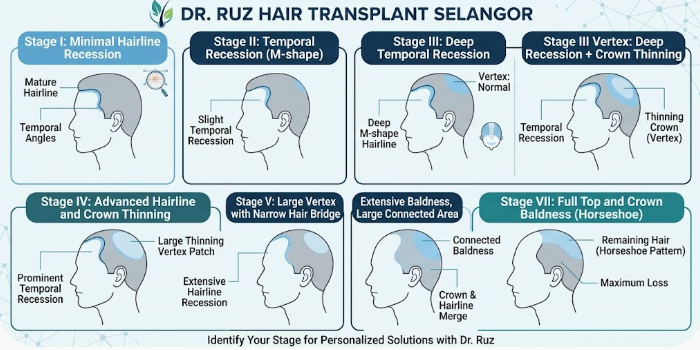
The most common reason people seek a hair transplant in Malaysia is androgenetic alopecia, also known as pattern hair loss.
This condition is influenced by genetics and hormones. It can affect both men and women.
In men, it often appears as:
- A receding hairline.
- Thinning at the temples.
- A widening bald spot at the crown.
- Gradual loss of hair across the top of the scalp.
In women, it may appear as:
- A widening parting.
- Thinning across the crown.
- Reduced density throughout the top of the scalp.
- A more visible scalp without a clearly receding hairline.
Because pattern hair loss often follows a recognisable pattern, we can plan a transplant more strategically.
For instance, we may restore a receding hairline, improve the appearance of the crown, or increase density in selected areas.
Nevertheless, a diagnosis is essential.
Not every type of hair loss responds well to transplantation. Therefore, we must first understand why your hair is thinning.
2. You Have Enough Healthy Donor Hair
Your donor area is one of the most important factors in hair transplant suitability.
Think of it as your natural hair reserve.
A good donor area contains healthy follicles that can potentially be moved to areas affected by hair loss. However, the amount of hair available varies from person to person.
Some people have dense donor hair. Others have finer hair or lower density.
Consequently, two patients with similar bald areas may require very different treatment plans.
During your assessment, we examine the density, thickness, and distribution of your donor hair. We also consider whether the donor area itself shows signs of thinning.
This matters because we want to avoid overharvesting.
A natural result requires both a suitable recipient area and a carefully protected donor area.
For example, a patient with a strong donor area may have enough hair to restore the frontal hairline. Another patient may need a more conservative design that prioritises the most visible areas.
In some cases, we may recommend medical treatment first. This can help preserve existing hair and improve the overall foundation for future restoration.
Therefore, donor assessment is not simply about counting hairs. It is about planning for the long term.
3. Your Hair Loss Pattern Is Stable Enough for Surgery
Hair loss does not always progress at the same speed.
Some people experience gradual thinning over many years. Others notice rapid changes within a short period.
This difference matters.
If your hair loss is still progressing quickly, performing a transplant too early may create an uneven result. For example, transplanted hair may remain while the surrounding native hair continues to thin.
Over time, this can make the result look less natural.
Therefore, we may recommend stabilising your hair loss before surgery.
Medical treatment can sometimes slow down progression and help preserve your existing follicles. Depending on your diagnosis, this may include treatments such as topical minoxidil or other medically appropriate options.
However, treatment suitability depends on your individual circumstances. Your doctor should discuss the benefits, risks, and possible side effects with you before you begin.
In some patients, medical treatment alone may improve density enough to delay or avoid surgery.
For others, it provides a stronger foundation for a future transplant.
The goal is not simply to restore the hair you have lost. It is also to protect the hair you still have.
4. You Are Old Enough for a Sensible Long-Term Plan
Age can influence hair transplant planning, but it is not the only factor.
Many younger patients experience hair loss in their late teens or early twenties. However, their final pattern may not yet be clear.
Consequently, performing surgery too early can create challenges later.
For example, a patient may restore a hairline at 21, only to experience further recession behind it over the following years.
That is why we often recommend a careful assessment of hair loss stability before proceeding.
In many cases, patients benefit from waiting until their pattern becomes clearer. However, age alone does not determine suitability.
A younger patient may still be suitable if the hair loss pattern is well understood and the treatment plan is appropriate.
Conversely, there is no strict upper age limit for everyone.
Older patients may also benefit from a transplant if they have:
- Good general health.
- A suitable donor area.
- A stable hair loss pattern.
- Realistic expectations.
- A treatment plan that matches their needs.
Therefore, the most important question is not simply, “How old are you?”
It is:
“Can we create a safe, natural-looking result that makes sense for your long-term hair?”
5. Your Scalp Is Healthy Enough for Treatment
A healthy scalp provides a better environment for hair restoration.
However, some scalp conditions can affect whether surgery is appropriate.
For example, active inflammation, infection, or certain scalp diseases may require treatment before a transplant.
Similarly, some forms of hair loss involve the immune system attacking hair follicles. In these situations, the underlying condition must be carefully assessed.
This is particularly important for conditions such as alopecia areata and some forms of scarring alopecia.
A transplant may not be suitable while the condition is active.
Therefore, we do not recommend surgery simply because someone has a bald area. We first need to understand what caused the hair loss.
During your consultation, we may examine your scalp closely and ask about:
- When your hair loss started.
- Whether the shedding is sudden or gradual.
- Whether you experience itching, redness, or pain.
- Whether you have a history of scalp conditions.
- Whether other family members have similar hair loss.
If necessary, we may recommend further medical assessment.
A correct diagnosis is the foundation of a successful hair restoration plan.
6. Your Hair Characteristics Can Support a Natural Result
Your hair type also influences the final appearance of a transplant.
For example, thick hair shafts can provide more visual coverage than very fine hair. Similarly, wavy or curly hair may create the appearance of greater density.
On the other hand, fine, straight hair may require more careful planning to achieve a similar visual effect.
This does not mean that people with fine hair cannot have excellent results.
Instead, it means we must design the transplant around your individual characteristics.
We consider factors such as:
- Hair thickness.
- Hair texture.
- Hair colour.
- Skin tone.
- Hair direction.
- Donor density.
- The size of the thinning area.
For example, dark hair against a lighter scalp may make thinning more noticeable. However, the same hair characteristics can also influence how much coverage a transplant provides.
Therefore, a successful design is not simply about placing as many grafts as possible.
It is about creating the right balance between density, direction, and natural appearance.
At Dr. Ruz Hair Transplant, we aim to design a hairline that looks appropriate for your age, facial features, and existing hair pattern.
7. You Are in Good General Health
A hair transplant is a surgical procedure, even though it is usually performed under local anaesthesia.
Therefore, your general health matters.
Before treatment, we need to understand whether any medical conditions or medications could affect your safety or healing.
For example, uncontrolled diabetes, certain cardiovascular conditions, or other significant medical issues may require additional assessment.
However, having a medical condition does not automatically mean you cannot undergo a transplant.
If your condition is well managed, you may still be suitable.
The important thing is to ensure that your treatment plan is safe and appropriate.
We may also ask about medications that affect bleeding or healing. If you take prescribed medication, you should not stop it without medical advice.
Similarly, smoking can affect wound healing and blood circulation. Therefore, we encourage patients to discuss smoking habits with their doctor before surgery.
Your safety comes first.
A good hair transplant is not only about the final appearance. It is also about the quality of care throughout the process.
8. You Have Realistic Expectations
This is one of the most important factors in hair transplant suitability.
A transplant can improve the appearance of thinning hair. However, it cannot always restore your hair to the exact density you had as a teenager.
Instead, the procedure redistributes your existing donor hair to create a fuller, more natural-looking appearance.
Therefore, the best candidates understand what the treatment can realistically achieve.
For example, someone may want to restore a receding hairline. Another person may want to improve the appearance of a thinning crown.
Both goals may be possible.
However, the amount of improvement depends on your donor supply, hair loss pattern, and treatment plan.
During your consultation, we discuss your goals and explain what may be achievable.
We also explain the limitations.
For example, if you have advanced hair loss, we may recommend prioritising the frontal hairline rather than trying to cover the entire scalp.
This approach often creates a more natural and balanced result.
The goal is not to give you someone else’s hairline. It is to create the best version of your own.
9. You Understand the Hair Transplant Recovery Timeline
Many patients expect to see their final result immediately after surgery.
However, hair restoration takes time.
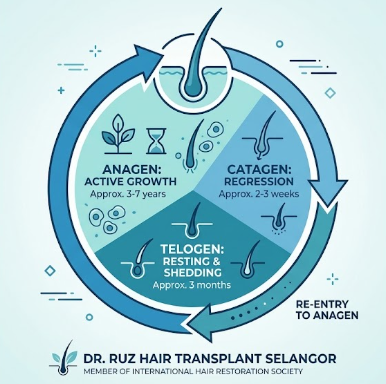
After a transplant, the newly placed hair may shed during the early recovery period. This is a normal part of the process.
New growth usually begins gradually over the following months.
For many patients, visible improvement becomes more noticeable around three to six months. However, the final result may continue developing for 12 to 18 months.
Therefore, patience is essential.
During this period, you may experience changes in hair growth, density, and appearance.
Some patients may also experience temporary shedding of existing hair around the transplant area.
This can be concerning, but it does not necessarily mean the procedure has failed.
Your doctor will explain what to expect and how to care for your scalp during recovery.
At Dr. Ruz Hair Transplant of Hair Transplant Malaysia, we believe follow-up care is an important part of the treatment journey.
Our team provides comprehensive follow-up for up to 18 months, helping us monitor your progress and guide you through the different stages of growth.
Hair restoration is a process, not an overnight transformation.
10. You Are Willing to Protect Your Existing Hair – Hair Transplant Malaysia
A transplant can restore hair to areas affected by hair loss. However, it does not necessarily stop future thinning of your existing hair.
This is particularly important for patients with pattern hair loss.
For example, transplanted hair may remain while the surrounding native hair continues to thin.
Therefore, many patients benefit from a long-term hair management plan.
Depending on your diagnosis, this may include medical treatment, scalp care, and regular monitoring.
The exact approach should be personalised.
Some patients may need treatment before surgery. Others may benefit from continuing treatment after surgery.
The purpose is simple:
To help protect your existing hair and maintain a natural-looking result over time.
At Dr. Ruz Hair Transplant, we do not view surgery as the end of your hair restoration journey.
Instead, we see it as one part of a long-term plan.
FUT or FUE: Which Technique Is Suitable for You?
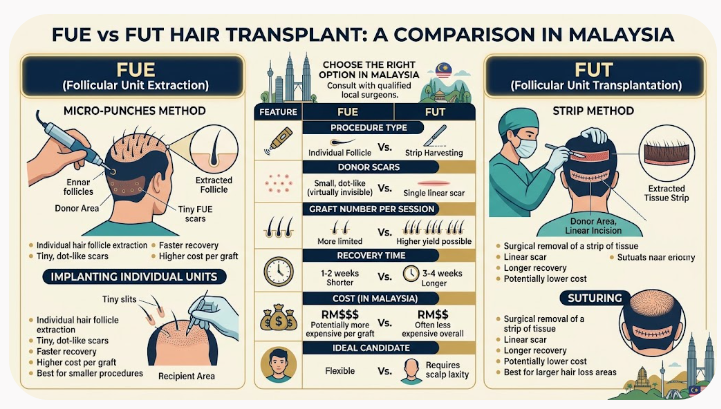
Once we determine that you may benefit from a transplant, we can discuss the most appropriate technique.
The two main approaches are FUT and FUE.
FUT: Follicular Unit Transplantation – Hair Transplant Malaysia
FUT involves removing a strip of scalp from the donor area. The hair follicles are then separated and prepared for transplantation.
This technique can be useful for selected patients who require a larger number of grafts.
However, it leaves a linear scar at the back of the scalp.
Therefore, FUT may be more suitable for patients who prefer to keep their hair at a medium or longer length.
FUE: Follicular Unit Extraction – Hair Transplant Malaysia
FUE involves harvesting individual follicular units from the donor area.
This technique does not require removing a strip of scalp.
Instead, the follicles are extracted individually using specialised instruments.
FUE may be suitable for patients who prefer shorter hairstyles or who want to avoid a linear scar.
However, FUE is not automatically the best option for everyone.
The most appropriate technique depends on your donor area, hair characteristics, treatment goals, and medical assessment.
The best technique is the one that suits your scalp and your long-term goals.
Who May Not Be Suitable for a Hair Transplant?
A transplant may not be the right option for everyone.
For example, you may need to delay surgery if:
- Your hair loss is still progressing rapidly.
- Your donor area is too thin.
- You have an active scalp condition.
- You have unrealistic expectations.
- Your general health requires further assessment.
- You have not yet explored suitable medical treatment.
- You want a result that your available donor hair cannot realistically provide.
However, being unsuitable today does not always mean being unsuitable forever.
Sometimes, the best next step is to stabilise your hair loss, treat an underlying condition, or reassess your donor area after some time.
That is why a proper consultation matters.
A responsible hair transplant clinic should be willing to tell you when surgery is not the right choice.
Why Choose Dr. Ruz Hair Transplant in Malaysia?
Choosing a hair transplant clinic is an important decision.
You are not simply choosing a procedure. You are choosing a team that will assess your hair, design your treatment, perform your surgery, and guide you through recovery.
At Dr. Ruz Hair Transplant, we focus on a personalised approach.
Our goal is to understand your hair loss before recommending treatment.
We also believe that good communication is essential.
During your consultation, we discuss your concerns, examine your scalp, and explain your options in clear language.
If surgery is suitable, we help you understand the expected results and recovery timeline.
If medical treatment is more appropriate, we explain that too.
Furthermore, our comprehensive follow-up programme provides support for up to 18 months after your procedure.
This allows us to monitor your progress and help you understand the different stages of hair growth.
We believe that natural-looking results begin with honest advice and careful planning.
Conclusion: The First Step Is a Proper Assessment
If you are considering a hair transplant in Malaysia, the first step is not necessarily booking surgery.
Instead, it is understanding your hair loss.
A suitable candidate usually has a stable hair loss pattern, sufficient donor hair, a healthy scalp, and realistic expectations.
However, every patient is different.
Some people may benefit from a transplant immediately. Others may need medical treatment first. In some cases, a transplant may not be the most suitable option.
Therefore, the best way to know whether you are a candidate is to have a proper consultation.
At Dr. Ruz Hair Transplant, we take the time to understand your concerns and evaluate your hair loss.
We then work with you to develop a treatment plan that suits your needs.
Your hair restoration journey should begin with the right diagnosis, the right plan, and the right expectations.
If you are ready to explore your options, visit drruzhairtransplant.com to learn more about our hair transplant services in Malaysia.
You can also contact our team to arrange a consultation and find out whether a hair transplant is suitable for you.
Because your confidence determines your future.